The best time for a 4D ultrasound is the question we get more than almost any other — and the honest answer is more nuanced than "third trimester." Your baby's development, the type of imaging you want, your specific goals for the session, and even the position of your placenta all play a role in when your visit will deliver the clearest, most emotionally satisfying results. This guide breaks it down week by week so you can stop guessing and book with confidence.
Last reviewed: July 2026
The best time for a 4D ultrasound is typically between 26 and 32 weeks of pregnancy. At this stage, your baby has developed enough subcutaneous fat to give facial features their soft, rounded appearance, while still having enough amniotic fluid and room to move for expressive moments on screen. Before 26 weeks, features are often less defined. After 32 weeks, space tightens and baby tends to face the placenta or uterine wall more consistently.
Most expecting parents assume 4D ultrasound quality depends mainly on the equipment. It does — but timing accounts for an enormous portion of why some sessions produce stunning images and others don't. A technically perfect 4D machine cannot give your baby's face features it hasn't developed yet.
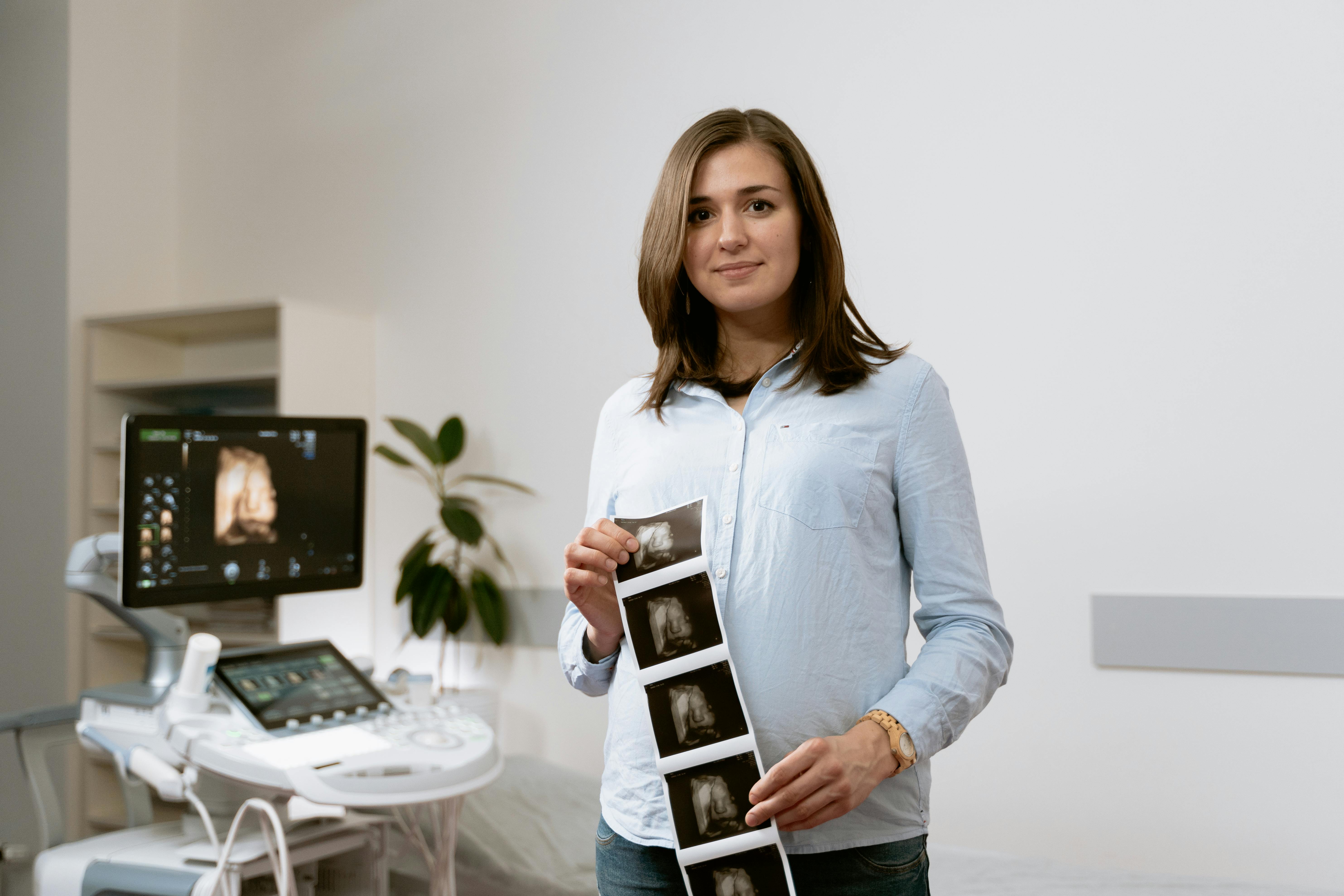
What determines image quality at any given week comes down to three biological factors:
Subcutaneous fat development. Your baby builds fat under the skin during the second and third trimesters. This fat layer is what gives cheeks, lips, and nose their characteristic roundness in 3D and 4D images. Babies earlier in the second trimester look angular because the fat isn't there yet.
Amniotic fluid volume. Fluid acts as the medium through which the ultrasound signal travels. More fluid generally means clearer imaging. Fluid levels peak in the third trimester and then decline slightly toward term, which is one reason very late bookings (36+ weeks) can sometimes produce less clear images despite fully developed features.
Baby's position and available space. As baby grows, they have less room to turn freely. Sessions before 30 weeks often involve more spontaneous movement — yawning, stretching, changing positions. After 32 weeks, baby is more likely to be head-down and settled, which can limit facial access.
Heartbeat keepsakes and early peeks. Baby is small and highly active. Facial features are forming but not yet defined enough for a satisfying 3D portrait. This is the ideal window for heartbeat animal keepsakes and early bonding visits. Not recommended as your primary 4D session.
Good for gender determination, early movement footage. Gender determination becomes reliable at 14+ weeks. 4D movement is visible and active, but facial features are still angular due to limited fat development. Good for families who want early visits; not optimal for detailed face shots.
Excellent movement window, emerging features. Baby is extremely active and expressive. 4D video captures great movement, gestures, and early facial expressions. Facial features improve through this range — 24 to 26 weeks is noticeably better than 20 to 22 weeks. Still not the optimal window for clear facial portraits.
The sweet spot for most families. Baby has developed significant facial fat, giving features their soft, recognizable appearance. Fluid levels are good. Movement is still frequent. This window delivers the most consistently satisfying 4D images. The peak window within this range is 28 to 30 weeks.
Fully developed features, tighter positioning. Baby's face is completely formed — the most recognizable images of any window. But baby is larger, often head-down, and has less room to move. Positioning can be more limited. Experienced sonographers can still get excellent results, especially at 32 to 34 weeks.
Possible but challenging. Baby is large, space is minimal, and fluid levels begin to decline. Results depend heavily on baby's position. Not the recommended window for first-time keepsake visits. Better as a late additional session for families who want a final check-in before delivery.
The 26 to 32 week window consistently produces the best 4D results — and it's worth understanding why, not just that it's true.
Around 26 weeks, baby's face starts to show the fat deposits that create those soft, rounded features most families are hoping to see. Cheeks fill in. Lips look full. The nose has definition. Before this point, even the best 4D imaging shows a face that looks somewhat angular or skeletal — not because anything is wrong, but because the fat that makes features look "baby-like" isn't there yet.
At 28 to 30 weeks, you get the full combination: developed features, high activity levels, good fluid, and enough space for baby to move and express. The session has the best chance of including the "baby yawning" or "baby waving" moments that make 4D so emotionally powerful.
By 32 weeks, the features are fully formed — arguably the sharpest window for face shots. But movement becomes less frequent as baby settles into a birth position. Families who book at 32 to 34 weeks often leave very happy with the images but have to work a little harder with positioning to get baby to face the camera.
Between 20 and 36 weeks, three things are changing simultaneously — and each one affects a different aspect of your session.
Fat development is the most visible change. A 3D still at 22 weeks looks noticeably different from one at 28 weeks, even from the same baby. The 22-week image shows a real face, but the contours are sharper and less rounded. The 28-week image shows something that looks like a newborn portrait — soft, full, recognizable.
Activity patterns shift too. In the 20 to 28 week range, baby tends to be more spontaneously active throughout the session. From 28 to 36 weeks, activity happens in more defined bursts separated by longer rest periods. The 4D experience of watching continuous movement gives way to shorter windows of expression. Both are beautiful — just different.
Space shrinks as baby grows. By 32 weeks, baby fills significantly more of the uterus. That's not a problem for imaging, but it does mean fewer angles are available and the sonographer may need to be more creative about where to place the transducer to find baby's face.
"Earlier is always better because baby is more active."
Activity doesn't determine image quality — fat development does. An active baby at 20 weeks won't produce the facial detail that a similar session at 28 weeks will.
"Later is better because features are more developed."
Features are fully developed by 32 to 34 weeks, but the combination of position limitations and fluid changes means 26 to 32 weeks usually beats 34+ for overall session quality.
"The equipment matters more than timing."
Both matter. High-quality equipment at 20 weeks cannot produce 28-week image quality. And poor timing with excellent equipment leaves families disappointed.
"If I miss the window, the session won't be worth it."
Sessions outside the optimal window can still be meaningful and produce good images — especially in the 32 to 36 week range. The "sweet spot" is a guideline, not a cutoff.
An anterior placenta — positioned on the front wall of the uterus — sits between the transducer and the baby. It acts as a partial barrier to the ultrasound signal, which can reduce image clarity and make certain angles more difficult. This doesn't make a session impossible, but it does make an experienced sonographer more important. With an anterior placenta, 28 to 30 weeks (rather than 26) tends to give better results, as baby has more room to turn and be reached from different angles.
Always tell your sonographer about your placenta position before the session starts. It shapes the entire technical approach.
Twins share space, which limits positioning options from earlier in pregnancy. The 24 to 28 week window tends to be more productive for twins than for singletons because space becomes more constrained as pregnancy progresses. Each twin's face may have varying accessibility depending on their relative positions — a skilled sonographer will work both babies across the session.
Families who discover keepsake ultrasound in the final weeks of pregnancy often worry they've missed their chance. You haven't. A session at 33 to 36 weeks can produce beautiful, fully defined facial images. Baby's features are completely there — what you're working against is positioning and space, not development. At Baby Realz, those sessions often surprise families who expected a compromise and got something close to what they'd hoped for.
If you're past 36 weeks and still want a session, reach out to Baby Realz directly to discuss what's realistic at your specific stage. The team will give you an honest assessment.
When you're ready to book your 4D session in Leesburg, VA, browse the Baby Realz ultrasound packages or visit the studio page to learn more about what the experience looks like before you arrive.
If you're booking one session and want the best odds of clear, emotionally satisfying images, aim for 28 to 30 weeks. That's the peak of the 26 to 32 week optimal window — enough fat development for soft facial features, active baby movement, and good fluid clarity. It's where most families who ask us directly tend to get their best results.
Yes. A session at 20 to 22 weeks can be a meaningful early experience, especially for 4D movement. But for the clearest facial 3D imaging, baby needs more fat development than is typically present at 20 weeks. Consider it a great early visit — and plan a second session at 28 to 30 weeks for the full keepsake experience.
No. Baby's features at 34 weeks are completely formed — if anything, the face looks more like a newborn portrait than at 28 weeks. What you're working with at 34+ weeks is tighter positioning and less fluid compared to the 28 to 30 week window. Experienced sonographers can still get excellent results, especially early in the 32 to 34 week range.
Yes, slightly. With an anterior placenta, the 28 to 30 week window is better than the 26 to 27 week range — baby has a bit more room to turn and be accessed from angles that avoid the placental barrier. Let your sonographer know about your placenta position when you book and again when you arrive.
Earlier in the third trimester window — 24 to 28 weeks tends to be the most productive for twins because space is more available than it will be later. After 30 weeks, positioning can become more limited as both babies take up more room. Every twin pregnancy is different, so discuss your specific situation when booking.
Somewhat. Baby activity often follows patterns throughout the day. Many families find their baby is more active in the late afternoon or evening. If you know your baby's active times from your own daily experience, booking around those windows can help maximize movement during the session.
Amniotic fluid clarity is directly affected by maternal hydration. Drinking extra water in the 24 to 48 hours before your session increases the clarity of the fluid that surrounds your baby, which the ultrasound signal travels through. Good fluid clarity = clearer images. This is one of the most impactful things families can do regardless of what week they book.
Many families do exactly this — one visit at 20 to 24 weeks for movement and activity, then a second visit at 28 to 32 weeks for detailed facial imaging. It's two different experiences from the same pregnancy, and many parents say they value having both. Baby Realz packages are designed with flexible options for multiple visits.
Yes. The optimal window is a guideline for maximizing your odds of the best images — it's not a cutoff for worthwhile sessions. Families who book at 33 to 36 weeks regularly leave Baby Realz with beautiful, meaningful keepsakes. The session may require a bit more patience with positioning, but the experience of watching your baby before delivery is meaningful regardless of when it happens.
Baby Realz in Leesburg, VA serves families across Northern Virginia and the DC Metro area. Amy Davidson, ARDMS, brings 27+ years of OB/GYN imaging experience to every keepsake session.
Book at Baby Realz880 Harrison St SE Suite 29/31, Leesburg, VA 20175 | (571) 571-4446
Elective 4D ultrasound sessions are designed for bonding and keepsake purposes. They are not intended to replace prenatal medical care, clinical ultrasound screening, or fetal diagnosis of any kind. Always follow your OB or midwife's prenatal care recommendations throughout your pregnancy.